

She didn’t think she would stay in this field. Then she became a CBC nurse.
In 2014, Priscilla was leaving her career in banking and landed in community-based care as a temporary thing until she figured out her next move.
Her mother had opened a residential care facility and needed a caregiver. Naturally, Priscilla offered to take on the role––“just temporarily.”
“I unexpectedly fell in love with caregiving and working with the older adult population,” Priscilla says.
Deciding to stay in the field, Priscilla became inspired to open her own community––an adult foster care home, which she opened in 2017. After operating her own home for a few years, assisted by the skills and knowledge she had honed as a caregiver, she then decided to take on a second role as the administrator in her mother’s residential care facility.
“As an administrator, I often stepped in as a med tech or caregiver, especially during the pandemic, and found that I truly enjoyed providing hands-on care and building relationships with residents,” Priscilla recalls.
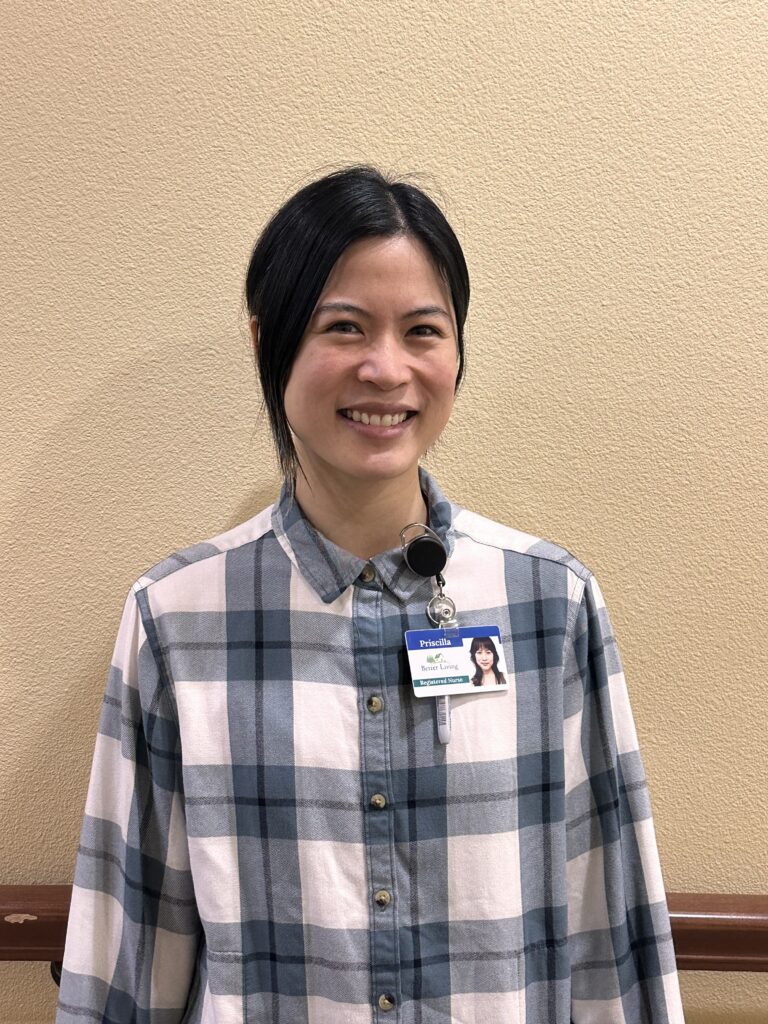
Eventually, she transferred ownership of her own care home and focused on her role as administrator for the residents in her mother’s facility.
“I loved listening to their life stories, problem-solving their concerns, and finding ways to support their needs,” she says. “As it turned out, I had a knack for getting to the bottom of complex issues and helping to resolve them. It was incredibly rewarding to see residents’ well-being improve—not just from my efforts, but from the care staff as well.”
Being an administrator and getting to look after this population was rewarding, but the role was not without its difficulties.
“The transition to Administrator was incredibly challenging, especially during the first two years when I was also operating my own adult foster care home,” she remembers.
“While I had the skills to successfully manage an adult foster care home with five residents, they weren’t enough to fully prepare me for the complexities of running a residential care facility. The licensing and regulatory requirements were very different from those of an adult foster care home,” she comments, “and it took me time to learn to change my approach.”
The non-clinical aspects of the role of administrator were the areas where Priscilla struggled most. “HR, payroll, accounting, hiring, the day-to-day business and facility operations…Although I was capable of these tasks, it didn’t excite me, and I felt it was taking me away from what I most wanted to focus on, which was the residents,” she comments.
On top of that, Priscilla was still learning how to thrive in her role as administrator when the COVID-19 pandemic hit. “It intensified the daily stress and operational challenges,” she says.
Often feeling overwhelmed with the volume of responsibility, she remembers feeling like she could never get through her to-do list, no matter how hard she worked, something that many in the field can relate to.
“Over time, I learned that being an effective administrator meant bringing order to chaos while honing strong communication, time management, and prioritization skills. It also required the ability to see the big picture and a willingness to adapt and explore new ways of doing things.”
At this point, Priscilla had gone from caregiver to adult foster care home owner and operator to residential care administrator. And then, Priscilla’s career took another turn.
“I knew I wanted to pursue nursing after I began working as a caregiver, but my drive for it grew even stronger when I became an administrator,” she remembers. “That experience made me realize that my true interest lay in the clinical side of community-based care, rather than the business aspect.”
In 2024, Priscilla graduated from nursing school. She immediately started working as a nurse in the same residential care facility that she had been an administrator in, which by that point had undergone a change in ownership.
“I had so many cheerleaders along the way who encouraged me to take the leap into nursing—residents, family members, and the nurse I worked alongside all played a role in pushing me forward,” Priscilla says.
“I also genuinely wanted a career that would allow me to use my strengths to make a positive impact on my community. With my experience as both an RCF administrator and now a nurse, I saw an opportunity to make the greatest impact in community-based nursing.”
Priscilla explains that as a nurse, she has, “a stronger voice in decision-making and advocacy. I can back my recommendations with clinical justifications, making it easier to influence meaningful changes.”
In a full-circle moment, she now has the chance to make that greater impact for the same residents she had cared for as a caregiver and then administrator.
“I chose to continue working in the same community for several reasons; I had already built strong relationships with the residents and staff, received support from management in pursuing my nursing goals, and wanted to use my role as a nurse to enhance the community I had helped shape.”
Priscilla loves her role as a nurse. “I love the holistic and collaborative nature of being a CBC nurse. Working closely with a team and seeing the positive impact on residents’ well-being is rewarding. I feel that CBC nursing also offers freedom and flexibility, allowing me to be creative in different ways. Additionally, I’ve discovered a passion for teaching and enjoy helping others build their skills and confidence.”
“I truly love this community,” she says fondly. “The residents, the team I work with, and the supportive environment.”
Like any new role, nursing came with a learning curve. “As a new nurse, I still struggle with self-doubt and the fear of making the wrong decision. With so much to learn, I must continuously challenge myself to build my knowledge and confidence,” Priscilla reflects.
To help with her transition into nursing, Priscilla enrolled in the NurseLearn Enhanced Program, a free mentored education program for nurses working in, or interested in, the nursing specialty field of community-based care.
“The Enhanced Program has given me a clearer understanding of my role and responsibilities as a CBC nurse,” she shares. “I especially appreciate the technical assistance sessions and case studies in the modules, as they help me connect what I’ve learned to real-life situations. This has helped shape my approach to specific challenges. I just want to thank NurseLearn for making this program accessible to so many people.”
For anyone considering becoming a nurse in community-based care, Priscilla has some words of wisdom: “Trust your instincts—if you feel drawn to nursing, don’t be afraid to take the leap. Initially, I thought becoming a nurse meant working in a hospital, but there are so many different paths in nursing. I think that community-based care nursing is unique because it allows you to build meaningful relationships with the people you care for while also offering greater autonomy in your practice,” she says. “If you are an administrator or work in CBC already, know that your skills and background give you a strong foundation to thrive as a CBC nurse.”
What’s coming next in Priscilla’s dynamic career? “I hope to earn my wound-care certification in the future, as wound care one of my favorite things to do at work!”